4th Grade

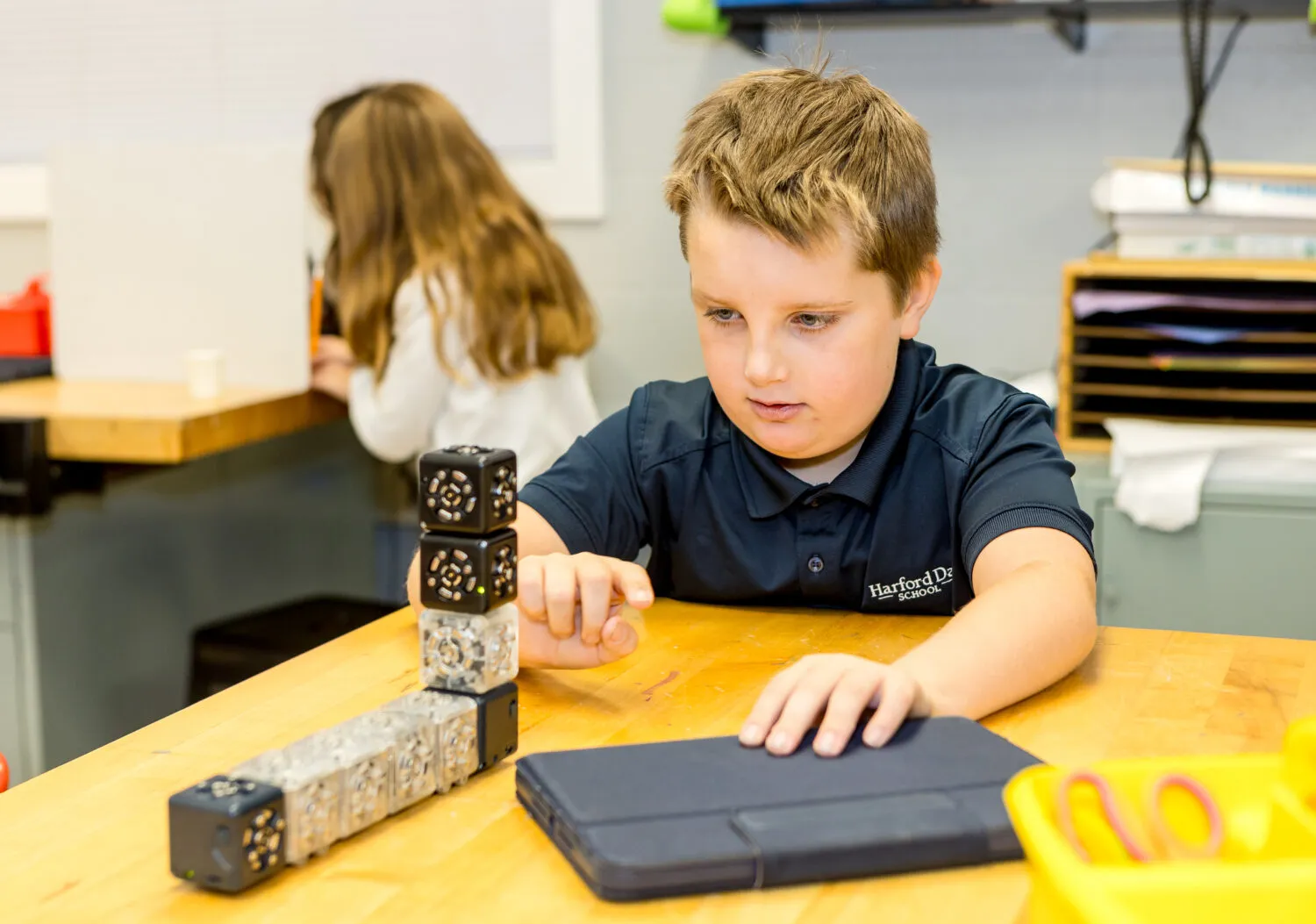
Fourth Grade focuses on applying the skills learned in the primary years while developing effective study habits, including managing materials and personal responsibilities. Curiosity—an essential trait for critical thinking and success—is nurtured through inquiry-based lessons across the curriculum. Students engage in author studies, character analysis, and explore themes in depth. In math, students continue to build their understanding by studying concepts in algebra, geometry, measurement, data analysis, and probability. Musical and dramatic talents are showcased through a class performance that highlights a key aspect of the Fourth Grade curriculum.
Fourth Graders are active and inquisitive learners who enjoy many hands-on, action-oriented activities. Field experiences may include trips to Philadelphia and The Living Classrooms. As the first year students receive letter grades, they gain greater independence, take on increased responsibilities, and begin to develop leadership skills. Additionally, Fourth Graders serve as Big Buddies to Harford Day School’s Pre-School students.

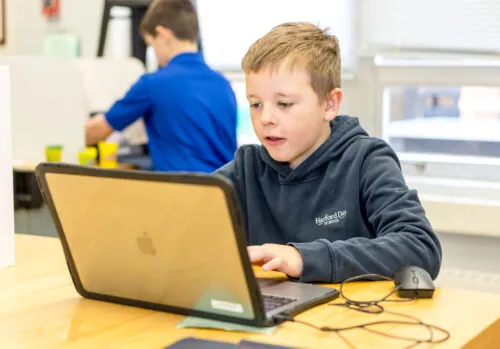
Language Arts skills are presented through reading a variety of trade books. Comprehension is taught and reinforced through the study of literature, including setting, plot, theme, character development, conflict, and cause/effect, as they develop higher-level thinking skills. Critical thinking skills are cultivated through the reading and discussion of a variety of novels. Analytical writing in response to texts read in class is introduced, as well as practice in writing narratives, descriptive pieces, persuasive essays, poems, and comparisons. Students also engage in lessons focusing on grammar concepts: sentence structure; parts of speech – nouns, verbs, pronouns, adjectives, adverbs, prepositions; usage – nouns/verbs – irregular plural forms, subject-verb agreement; irregular verb forms; adjectives; pronouns; mechanics (capitalization, punctuation). Vocabulary is taught in context using words chosen from current novels. Spelling patterns are reinforced and applied in written composition.
In math, students continue to gain a strong foundation of skills including place value, operations with whole numbers, and operations with fractions and decimals. Students examine number patterns and expressions to begin the study of pre-algebraic concepts. Measurement and geometry are also integral units in the course.
The major themes in science are studied each year in the lower school, including: classification, change over time, energy, engineering design, forces and interactions, measurement, problem solving/process/scientific methods, structure and function, systems, and collaborative discovery through hands-on explorations. In fourth grade, the course begins with the introduction to the scientific method and the processes used by scientists and includes an in-depth study of the Chesapeake Bay, a unit on astronomy, and an overview of the systems of the human body.
U.S. History is a survey course that transitions students into their first study of history as a discipline. Students begin by reviewing the basic elements of geography, mapping, and direction. They then study Native American tribes and progress through the Age of Exploration and the early colonization of America. The course culminates with a focus on the Revolutionary War.

Students reinforce their knowledge and use of the fundamental elements of art: line, shape, color, pattern, and texture. They focus on American art history yearlong with an emphasis on maritime-related art, which correlates with their studies of the Chesapeake Bay in other subject areas. Fundamental layout and design are introduced to create interesting and balanced posters, reports, and other visuals.
Students continue to work with the Dewey Decimal System and learn to recognize different genres of literature, expand reference skills, and use the automated library catalog system. They evaluate criteria for quality in books and participate in the Black-Eyed Susan Award Program, reading and evaluating picture books. Students gain experience using various websites. Students are exposed to proper care and use of computers, equipment, and software. There is a strong emphasis on logical thinking, etiquette, and manners, including those involved with email and password protection. Using Google Suite, Wixie, ABC ya, Education.com, and various web resources, students begin to master keyboarding, graphic design, presentations, desktop publishing, and word processing. Internet safety activities are used to demonstrate safe use of communication technologies.
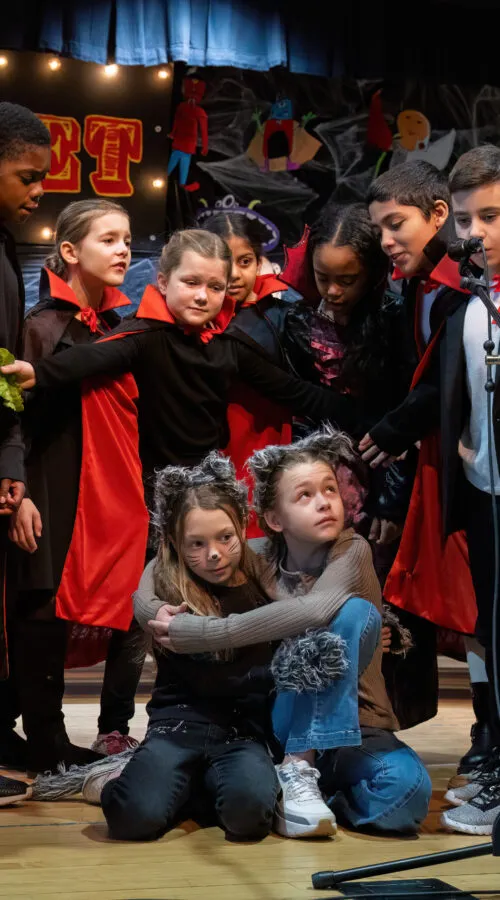
Fourth Graders apply their knowledge of rhythms and pitches in order to improvise and compose. They continue to accompany singing and play ensemble pieces on the xylophone. They sing in multiple parts and work on choral skills like singing in their head voices and blending. West African percussion gives them the opportunity to learn about other cultures, while challenging them with new rhythms. Their performances include the Holiday Program and Fourth Grade Musical.
Team sports may include: field hockey, soccer, basketball, Newcombe volleyball, flag football, kickball, and ultimate Frisbee. Teamwork, good sportsmanship, and fitness are stressed.
Spanish instruction includes the core elements of language instruction: reading, writing, speaking, and listening. Vocabulary acquisition and correct grammar are practiced through target language conversation, games, songs, and projects. Units include days of the week, months of the year, numbers, colors, greetings, holidays, family, and classroom objects. Students begin the study of the Spanish language syntax, including the conjugation of verbs. Students also study Hispanic cultural events such as the Day of the Dead and La Navidad.
